Bute vs Banamine for horses: a guide to equine pain relief
Bute (phenylbutazone) and Banamine (flunixin meglumine) are two different prescription nonsteroidal anti-inflammatory drugs (NSAIDs) for horses; vets tend to use bute for bone, joint and hoof pain and Banamine for colic, and the US labels give Banamine at 0.5 mg of flunixin per pound of body weight once a day, for up to 5 days for musculoskeletal pain (for colic, the injection label says it may be repeated when signs recur), and bute paste at 1 to 2 grams of phenylbutazone per 500 pounds a day by mouth, never more than 4 grams a day. Those are the figures on the Banamine injection, Banamine paste and bute paste labels approved by the FDA. Your vet sets the dose for your horse, and the two shouldn't be given together unless your vet decides so.
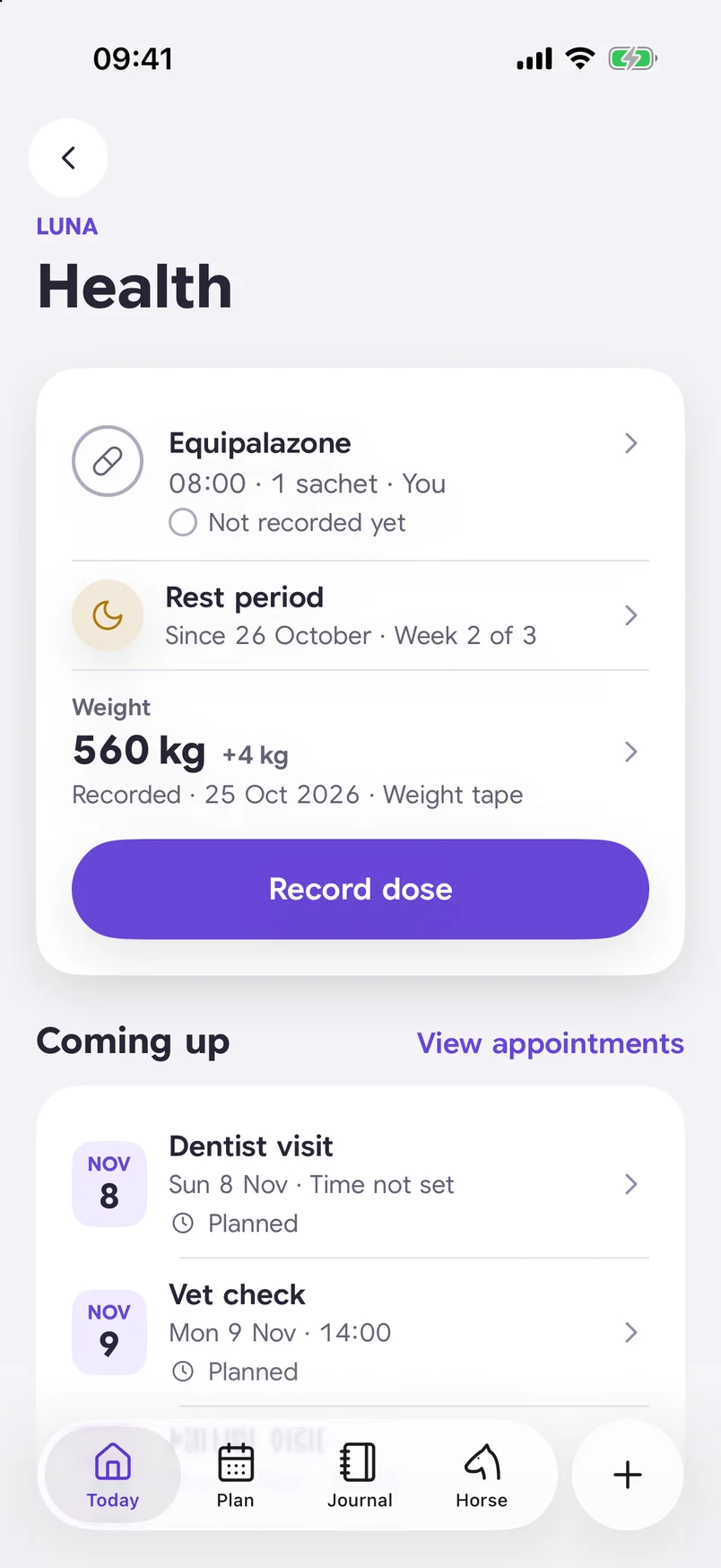
Even without an emergency, these two drugs are easy to lose track of. Your vet may change the dose after the first days, the instructions arrive by phone or in a text, and the horse is dosed by whoever happens to be at the barn: you in the morning, the barn manager at night, a friend on the weekend. A line on the whiteboard says "bute 2x" without a time or a name, the paste syringe is set to a mark nobody remembers turning, and when the vet asks what he has had in the last 24 hours, three people give three different answers. With bute and Banamine in the same tack trunk, that kind of uncertainty is how a second drug ends up on top of the first.
The short version
- Bute is phenylbutazone and Banamine is a brand of flunixin meglumine: two different NSAIDs, both prescription drugs in the US.
- Vets often use bute for bone and hoof pain and Banamine for colic, but a 2022 review found little evidence for that split.
- Never give both together without your vet: two NSAIDs act like a double dose of one.
- The main risks are ulcers in the stomach and gut, right dorsal colitis and kidney damage, mostly after too much or for too long.
On this page
Understanding equine pain relief: the basics of NSAIDs
Nonsteroidal anti-inflammatory drugs (NSAIDs) such as bute and Banamine reduce pain, inflammation and fever by blocking the COX-1 and COX-2 enzymes, and a 2022 University of Queensland review calls phenylbutazone "the most commonly administered NSAID in equine medicine". The same review says adequate analgesia is "essential for minimising physiologic stress, improving animal welfare, convalescence and increasing treatment success". The review lists what NSAIDs are used for in equine veterinary care: colic, muscle and bone pain, pain around surgery, corneal ulcers, uveitis and laminitis.
Blocking the same enzymes is also why the two drugs share their risks: COX-1 is found "in abundance in the gastrointestinal tract, kidneys and platelets". With two drugs from one family on the shelf, and more than one person giving them, keeping track of what went in is part of the treatment.
Bute vs Banamine: what is the main difference?
The main difference between bute and Banamine is the active ingredient and what each label covers: bute (phenylbutazone) is labeled for musculoskeletal inflammation, while the Banamine injection label covers musculoskeletal pain and also colic pain. For anyone weighing Banamine vs bute for horses, this is the comparison the labels and studies support:
| Bute | Banamine | |
|---|---|---|
| Active ingredient | Phenylbutazone | Flunixin meglumine (Banamine is Merck's brand) |
| US label use | "inflammatory conditions associated with the musculoskeletal system" | Musculoskeletal pain and inflammation; the injection also "visceral pain associated with colic" |
| US forms | Paste, powder, tablets, injection | Injection, paste |
| Injection route | Into the vein only | Vein or muscle on the label; Minnesota advises against the muscle |
| Where it did better (BEVA 2020) | Hoof pain and laminitis, against meloxicam and firocoxib | Colic, against meloxicam and bute |
| Ulcer risk | Greater than flunixin, per Merck | Lower than bute; Merck says "Toxicity in horses is relatively uncommon, but gastrointestinal erosion and ulceration may develop." |
The British Equine Veterinary Association's 2020 guideline found that bute "provided superior analgesia to meloxicam and firocoxib for hoof pain/laminitis", while "In horses with colic, flunixin and firocoxib are considered to provide more effective analgesia than meloxicam or phenylbutazone", both with moderate certainty. The 2022 review adds a caution about the bute versus Banamine rule of thumb: there is "little evidence to support such tissue selectivity".
When to use bute for horses
Vets use bute for horses mainly for musculoskeletal pain and inflammation, and the Merck Veterinary Manual says "One of the major therapeutic uses of PBZ is to treat acute laminitis in horses."
Common uses
The US paste label approves bute "for the relief of inflammatory conditions associated with the musculoskeletal system in horses", and says its pain relief "is probably related mainly to the compound's anti-inflammatory properties". It is not a steroid, and it lowers fever too. In the BEVA guideline, its advantage for hoof pain and laminitis "has not been demonstrated for joint pain". Easing pain doesn't treat the cause, and the University of Minnesota warns that "Phenylbutazone can hide signs that your veterinarian will use to assess the problem."
Proper administration and dosage risks
The bute dosage for horses on the US labels is a daily amount with a ceiling, and your vet sets the dose from your horse's weight and condition:
| Product, as labeled | Label dose | Route and limit | Source |
|---|---|---|---|
| Bute paste, 1 g per 3 mL marking | 1 to 2 g per 500 lb a day; higher for the first 48 hours, then reduced | By mouth; not more than 4 g daily; reevaluate if no response after 5 days | US label |
| Bute tablets (boluses), 1 g each | 1 to 2 boluses per 500 lb | By mouth; not more than 4 g daily; "Reduce dosage as symptoms regress" | US label |
| Bute injection, 200 mg per mL | 1 to 2 g per 1,000 lb (5 to 10 mL per 1,000 lb) a day | Into the vein only, slowly; not more than 5 successive days | US label |
| UK bute sachets, 1 g each | For a 450 kg (1,000 lb) horse: 2 sachets twice on day one, 1 sachet twice daily for four days, then 1 sachet daily or on alternate days | Oral use; stop if no response after four to five days | UK product information |
Note that the injection label counts per 1,000 lb and the paste and tablet labels per 500 lb. The paste label says "Maintain lowest dose capable of producing desired clinical response" and recommends routine blood counts "at weekly intervals during the early phase of therapy and at intervals of two weeks thereafter". A label dose isn't automatically harmless: Merck illustrates right dorsal colitis with a horse whose colitis was "caused by a course of phenylbutazone at label dosing", and it says bute's "ulcerogenic potential" is greater than flunixin's. The UK label warns that "The therapeutic index of phenylbutazone is low.", and that its effect "can be evident for at least three days following cessation of administration", which matters before a soundness exam.
When to use Banamine for horses
Vets use Banamine for musculoskeletal pain and, as an injection, for colic: the US injection label recommends it "for the alleviation of visceral pain associated with colic in the horse".
Common uses
Banamine for colic is an injection use: the paste label covers only "inflammation and pain associated with musculoskeletal disorders", which is worth knowing before you compare Banamine paste vs bute for horses with a sore belly. The injection label calls flunixin "a potent, non-narcotic, nonsteroidal, analgesic agent with anti-inflammatory and antipyretic activity", so it also lowers fever, and in very sick horses Merck describes it being used against the effects of endotoxin, a bacterial toxin in the blood, though Merck adds that it is "unlikely to reduce mortality associated with endotoxemic shock". The Banamine effects on horses, per the label: activity starts within 2 hours, peaks between 12 and 16 hours and lasts 24 to 36 hours. It doesn't cure colic: "The cause of colic should be determined and treated with concomitant therapy."
Oral vs IV administration
| Product, as labeled | Label dose | Route and limit | Source |
|---|---|---|---|
| Banamine injection, 50 mg flunixin per mL | 0.5 mg per lb (1 mL per 100 lb), once daily for musculoskeletal pain; for colic, may be repeated when signs recur | Vein or muscle; the vein "for prompt relief" in colic; up to 5 days for musculoskeletal pain | US label |
| Banamine paste, 1,500 mg flunixin per syringe | 0.5 mg per lb once daily; the 1,000 lb mark gives 500 mg | By mouth; not more than 5 consecutive days | US label |
At the Banamine injection label's rate of 1 mL per 100 lb, a 1,000 lb horse gets 10 mL (10 cc), which only works if the weight is right. The paste label allows a vet to start with an injection, "followed by BANAMINE Granules or BANAMINE Paste on Days 2 to 5". Minnesota's advice is to give Banamine by mouth or have your vet give it in the vein; it calls the risk of clostridial myositis "relatively low", but "Between 31 and 73 percent of horses survive Clostridial myositis". The label also says "Intra-arterial injection should be avoided", and for bute, injection into the muscle is ruled out on the label altogether.
Risks of mixing or mismanaging equine medications
Giving bute and Banamine together acts like a double dose of one NSAID: the 2022 review calls it "stacking", says "This practice is contraindicated", and notes it adds risk "without any additional analgesic benefit". In a University of Missouri study by Reed and colleagues (2006), one horse was euthanized with severe protein loss and colitis during bute plus flunixin, and four horses examined showed substantial stomach ulcers. The UK bute label says not to give it with another NSAID "concurrently or within 24 hours of each other"; the US Banamine injection and bute tablet labels say combining should be "avoided or closely monitored".
The bute side effects, and those of Banamine, come mostly from too much or too long. The review names "gastroduodenal ulceration, right dorsal colitis (RDC) and renal papillary necrosis" as the three main side effects of "excessive or prolonged NSAID usage". In a 2023 study of 35 horses with right dorsal colitis, the case fatality rate was 43%, and "An overdose of NSAIDs occurred in 84% (21/25) cases where dose was known." Dehydrated horses, ponies, foals, old horses and horses with heart, liver or kidney problems are at greater risk, according to the US Banamine label, the review and the UK bute label. Call your vet if a horse on either drug goes off its feed, gets diarrhea or colic, or passes dark manure; the US bute label says "black or tarry stools should be regarded as a signal for immediate cessation of therapy".
Mismanagement often starts at home. The review found that "Clients self-administering horses with NSAIDs without consulting a veterinarian is a common cause of NSAID toxicity", and that "clients may not disclose the actual amount of drugs that has administered to the horse".
Conclusion: work with your vet for safe pain management
Call your vet before giving either drug, and always for colic: the University of Minnesota says to give medications for colic "ONLY if your veterinarian approves it." The Merck Veterinary Manual's colic chapter says "Clinical experience suggests that flunixin meglumine may mask the early signs of conditions requiring surgery", and Minnesota warns that "Colic can be fatal if a gut is twisted for 6 hours or more." While you wait, its advice for colic is to "Monitor any vital signs you know (heart rate, mucous membrane color)." Both drugs need a prescription: the US Banamine and bute injection labels say "Federal law restricts this drug to use by or on the order of a licensed veterinarian". The BEVA guideline puts pain management in horses in the vet's hands: these drugs should be used "only under the control of a veterinary surgeon who has fully evaluated a horse and developed a therapeutic, analgesic plan that includes ongoing monitoring".
When you call, or before the vet arrives, have this ready:
- which drug was given, by its active ingredient if you can find it on the packet, not just "the paste";
- when it was given, how much, and by whom;
- any other medication, including steroids, antibiotics and equine health supplements;
- whether your horse has been eating and drinking normally.
If you're looking for alternative pain relief for horses, ask your vet: among the alternatives with evidence behind them are other NSAIDs such as firocoxib and meloxicam, which the BEVA guideline compares with bute. Our guides to contacting your vet and keeping medication records show how to keep the details straight.
More questions about bute and Banamine
How much Banamine can you give a 1000 lb horse?
On the US paste label, 500 mg of flunixin, the 1,000 mark on the syringe, once a day for no more than 5 consecutive days. The injection label gives 0.5 mg per pound, stated as 1 mL per 100 lb. Your vet sets the dose for your horse.
How long after bute can I give Banamine?
The UK bute label says not "concurrently or within 24 hours of each other"; the US labels set no gap. Whether a second NSAID is right at all is your vet's decision.
Can a horse compete on bute or Banamine?
In disciplines under US Equestrian's therapeutic rules (FEI-governed disciplines follow the FEI's own list), one NSAID such as bute or flunixin is permitted up to a set maximum level in the blood, but more than one NSAID in the blood or urine is a violation, with a narrow exception for flunixin given by a vet for colic or an eye emergency, after which the horse is withdrawn from competition for a set period. The FEI lists phenylbutazone and flunixin as "Prohibited Substance - Controlled Medication".
Can a horse treated with bute go into the food chain?
No. The US bute paste label says "Do not use in horses intended for human consumption", and the UK label says "Treated horses may never be slaughtered for human consumption."
Can humans take bute or Banamine?
No. The US bute injection is labeled "For Horses Only Not For Use in Humans". If someone swallows it, the UK label says to "seek medical advice immediately and show the veterinary medicinal product packaging".