Understanding Cushing's Disease in Horses: Signs, Symptoms, and Daily Care
Cushing's disease in horses, properly called pituitary pars intermedia dysfunction (PPID), is a slowly progressing, age-related hormone disorder that affects about one in five horses and ponies over 15, and its classic sign is a long coat that doesn't shed. The FDA describes it as "also known as Equine Cushing's Disease, an endocrine condition affecting the pituitary gland of horses". There is no cure, but a daily tablet, pergolide, controls the signs in most horses, and a 2026 comparison study found that horses with PPID don't have shorter lives. Noticing the signs early pays off: in a 2026 study of 213 horses diagnosed in US primary care practice, diagnosis at a younger age and frequent monitoring were associated with better outcomes.
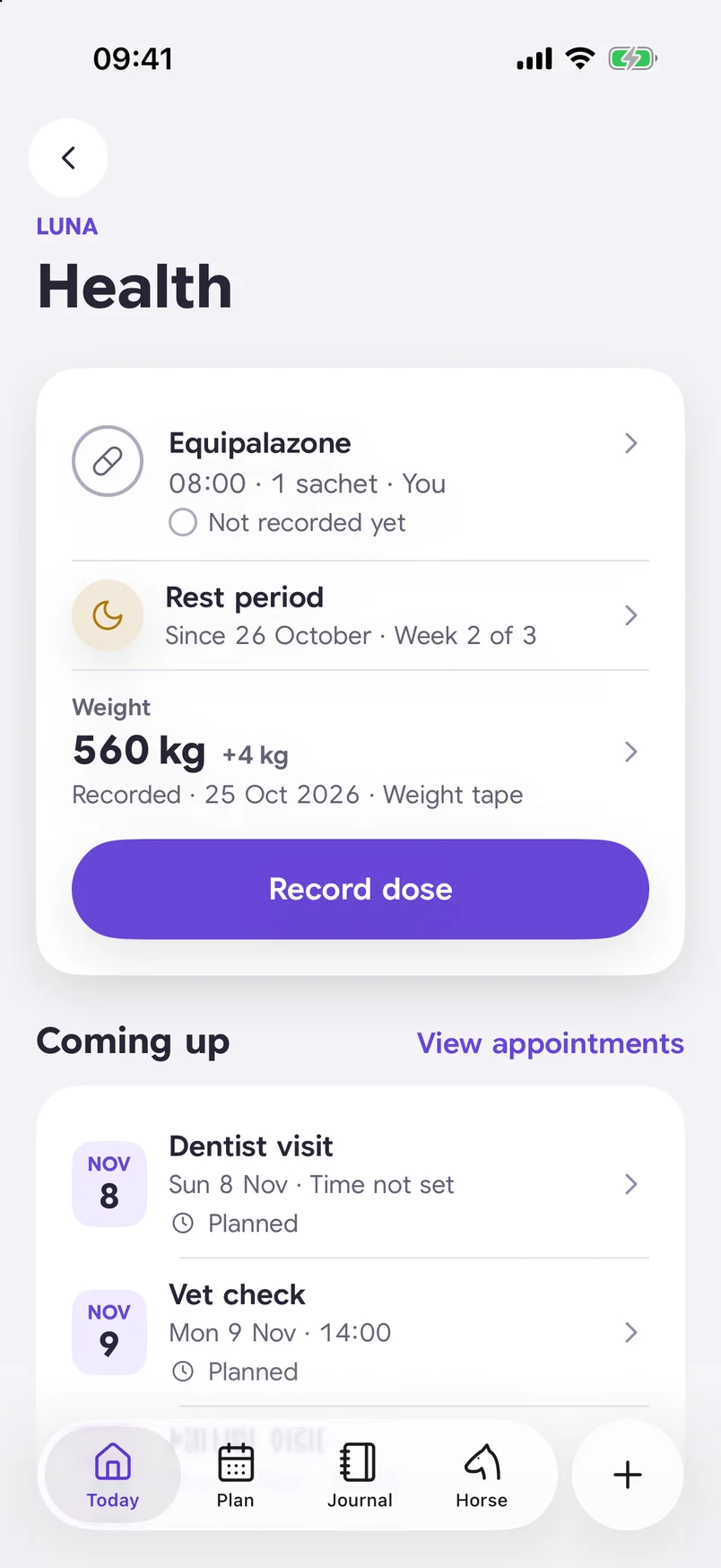
Once the diagnosis is made, living with PPID is mostly a job of keeping track. The pergolide has to go in every single day, often from the hands of whoever feeds that morning, and the tablet box can't tell you whether today's dose went into the feed or onto the stall floor. The date of the last ACTH test sits on an invoice somewhere, the vet's message about the dose change is buried in a text thread, the feed room still has last month's instructions taped to the door, and the photos that would show whether he shed better than last spring are scattered through a camera roll full of everything else. When the vet asks at the recheck how he's been, you end up answering from memory.
The short version
| Question | Answer |
|---|---|
| What is it? | A degenerative disease of the nerve cells that control the pituitary gland, which then enlarges and releases too much ACTH and related hormones |
| Who gets it? | Mostly horses and ponies of 15 and older; about 21% of horses over 15 in a 2013 study; uncommon under 10 |
| First signs | A long coat that sheds late or not at all, sometimes first on the legs, belly and throat; some loss of topline muscle; less energy |
| How is it tested? | A blood test for ACTH at rest, or a TRH stimulation test, plus an insulin test; autumn values are higher, so your vet chooses the timing |
| Treatment | Pergolide by mouth once a day, for life, starting at 2 mcg/kg on the US label (Prascend, or the generic Zygolide since January 2026), on prescription |
| Biggest risk | Laminitis, mainly when the horse also has insulin dysregulation, the core of equine metabolic syndrome |
| Life expectancy | A 2026 study found horses with PPID were not euthanized younger than horses without it |
On this page
What is Cushing's disease in horses (PPID)?
PPID in horses is a slowly progressive, age-related disease in which the dopamine-producing nerve cells that normally keep part of the pituitary gland in check degenerate, so that part enlarges and releases too much hormone. The Equine Endocrinology Group (EEG), a panel of veterinary specialists, describes it in its 2025 recommendations as a "degenerative disease of dopaminergic neurons in the hypothalamus" that "results in hyperplasia and adenoma formation of the pars intermedia of the pituitary gland". The enlarged gland then releases more ACTH (adrenocorticotropic hormone) and related hormones. The names overlap: a 2011 review calls it PPID, "also known as equine Cushing's syndrome", and the Royal Veterinary College says Equine Cushing's disease "is more correctly known as pituitary pars intermedia dysfunction (PPID)."
It's one of the common horse diseases of old age. About 21% of horses and ponies aged 15 and over had PPID in a 2013 study that tested them, even though their owners rarely reported it. The EEG gives 20% of equids over 15 and 30% of those over 30, and the British veterinary guideline calls the chance of PPID low in horses under 10.
What causes Cushing's disease in horses?
Age-related damage to the dopamine-producing nerve cells that control the middle part of the pituitary gland causes Cushing's disease in horses; what sets that damage off is still unknown. Oxidative damage is thought to play a role, but the trigger has yet to be determined, according to a 2025 review by Menzies-Gow. A 2018 review found that increasing age is the only proven risk factor. You'll sometimes read that Cushing's is "caused by a benign tumor", which is only partly right: in the same 2025 review, the growth in the pituitary is a consequence of the nerve damage, and it begins as an enlargement before it becomes an adenoma.
Cushing's disease vs equine metabolic syndrome
Cushing's disease and equine metabolic syndrome (EMS) are two different conditions that often occur together, and insulin dysregulation, the core of EMS, is what drives most of the laminitis risk in a horse with PPID. The Merck Veterinary Manual defines EMS as "a characteristic collection of clinical signs and clinicopathological changes in equids that increases their risk for developing hyperinsulinemia-associated laminitis". It says the two "can occur concurrently in middle-aged and older horses in approximately 30% of cases", that EMS usually appears between the ages of 5 and 16, and that "horses with just PPID, and not ID, rarely develop laminitis".
| Cushing's disease (PPID) | Equine metabolic syndrome (EMS) | |
|---|---|---|
| What goes wrong | The pituitary gland releases too much ACTH | Insulin dysregulation |
| Typical age | Mostly 15 and older | Usually appears between 5 and 16 |
| Main test | ACTH, at rest or after TRH | Insulin |
| Laminitis | Rare with PPID alone | High-insulin laminitis is over 90% of all laminitis |
Sources: EEG PPID recommendations, 2025; Merck, Equine Metabolic Syndrome, 2025; EEG EMS recommendations, 2024.
A 2025 review calls laminitis the sign of PPID with the greatest potential impact on quality of life. So when your vet tests for Cushing's, expect an insulin test as well.
Early signs of Cushing's disease in horses to watch for
The first signs of Cushing's disease in horses are usually a coat that sheds late or incompletely, often with longer hair on the legs, belly and throat, followed by some loss of muscle along the back and a horse that seems duller or works less well. The Merck Veterinary Manual notes that before the whole coat is affected, horses "may have longer hair on the legs, ventral abdomen, and throat latch."
Picture an old gelding in May, still in his winter coat while every other horse in the field is sleek. When owners ask what are the first signs of Cushing's disease in horses, that coat is usually the answer, and it's worth taking seriously: an Australian study of horses aged 15 and over found that an owner's report of a long or late-shedding coat was the strongest single predictor of PPID after age, and its authors advise testing aged horses with that history. The EEG sorts the symptoms of Cushing's disease in horses like this:
| Early signs | Advanced signs |
|---|---|
| Patches of long hair, delayed shedding | A long coat all over that doesn't shed |
| Some loss of topline muscle | Clear muscle wasting along the back, a rounded belly |
| Lethargy or a change in attitude | Altered mentation |
| Decreased performance | Exercise intolerance |
| Abnormal sweating, more or less than usual | Abnormal sweating, drinking and urinating more, recurrent infections, poor wound healing |
Source: EEG recommendations, 2025. The more signs a horse has, and the older he is, the more likely they point to PPID.
Coat changes (hirsutism)
A long coat that doesn't shed, called hirsutism or hypertrichosis, is the classic sign of Cushing's disease in horses. Merck explains that it "often becomes evident because of a failure in the cyclical seasonal shedding of hair", and the longer hair can show first on the legs, the underside of the belly and the throat. Because shedding happens slowly, a practical way to judge it is the same photo of the same side of the horse, taken each month through spring, so you can see whether this year's coat is coming out later than last year's.
Body and muscle changes
Loss of topline muscle, a rounded belly, weight loss and fat in unusual places are the body changes to look for. Weight loss and muscle wasting both appear in the list of signs a University of Illinois vet gives. For equine weight loss linked to PPID, the EEG notes that many horses with PPID "are lean and/or have muscle wasting", and it counts some loss of topline muscle as an early sign. Fat can go the other way at the same time: Merck's table of common signs includes "regional adiposity; increased fat on neck, topline, and tail head; bulging supraorbital fat pads", the supraorbital pads being the fat pads just above the eyes.
Changes like these creep up over months, which makes them hard to judge from memory. A dated photo of the coat and topline in March and another in June gives the vet a direct comparison instead of a description.
Behavioral and other changes
A horse with early PPID often seems quieter, duller or less willing at work, and may drink, urinate and sweat more or less than usual. The EEG lists "change in attitude/lethargy" and "decreased performance" among the early signs, and altered mentation and exercise intolerance in later stages. It lists abnormal sweating among both early and advanced signs, and increased drinking and urination (polydipsia and polyuria) among the advanced ones. Merck says increased drinking and urination in a suspected case must be told apart from kidney disease or diabetes insipidus, so it's a reason for bloodwork, not a diagnosis by itself. The 2025 review advises unrestricted access to water for horses that drink more.
In late-stage Cushing's the coat stays long all year, the topline wastes away, and infections, hoof abscesses and slow-healing wounds keep coming back. The EEG also lists recurrent corneal ulcers and higher worm egg counts. Merck names blindness and seizures among the uncommon signs, which the Royal Veterinary College explains by pressure of the enlarged gland on the brain.
The path to diagnosis: tests and veterinary assessments
Your vet diagnoses Cushing's disease in horses from the signs plus a blood test for ACTH, taken either at rest or before and after an injection of TRH, and reads the result against values for the time of year. The EEG calls this "currently the most practical diagnostic test for PPID", while warning that false positives and false negatives are possible, especially early on.
What happens when the vet comes out
Veterinary care for horses with suspected PPID starts with the signs you've noticed, because the EEG advises against testing a horse that shows none. The EEG's diagnostic steps start from those signs: how many there are and how advanced they look decide which test the vet picks. In an older horse with clear, advanced signs, the EEG says the vet may diagnose PPID without a test at all. Otherwise a blood sample is taken. Merck adds that horses with a long coat "should be tested for insulin dysregulation", and the EEG's EMS guideline recommends testing horses older than 10 for both PPID and insulin dysregulation.
What helps on test day, according to the EEG: a calm horse, no trailer ride in the 30 minutes before the sample, no sedation in the previous 24 hours, and no grain meal in the four hours before a TRH test (hay is fine).
ACTH and TRH tests, and why the season matters
Testing for Cushing's disease in horses uses either a single resting ACTH sample or a TRH stimulation test, in which ACTH is measured before and after a TRH injection, and both are read against the month the sample was taken. The EEG notes that a resting ACTH alone may be less supportive in the early stages than the TRH test, so early-stage Cushing's disease in horses is the hardest to confirm, and it advises re-evaluating a grey-zone result in 3 to 6 months. Healthy horses have higher ACTH in late summer and autumn: a 2025 Cornell study of horses across the US found ACTH was highest in late August, September and early October at every latitude. Labs use higher cutoffs in those months, and some vets avoid the TRH test in autumn.
After diagnosis, the EEG recommends a recheck 1 to 3 months after starting treatment, then every 6 to 12 months, ideally in the same season each year so the results compare. Improvement in the horse matters more than the number. Because the season moves ACTH, the test date and the month belong next to every result you keep.
Questions to ask your vet
These follow from the guidelines above and help you leave the visit with a plan:
- Should we test insulin at the same time as ACTH?
- Which test are we using, and does this month change how you read the result?
- When is the first recheck after starting pergolide, and which month should we retest each year?
- Does he need a restricted diet, or more calories?
- How often should the farrier and dentist see him from now on?
Treatment and daily management for equine Cushing's
Treatment for Cushing's disease in horses is pergolide, a tablet given by mouth once a day for the rest of the horse's life, together with a diet that fits his insulin status, hoof care and good routine care. Pergolide doesn't cure PPID; it lowers ACTH and controls the signs, so treating Cushing's disease in horses is a daily routine rather than a course that ends.
Medication: pergolide every day
Pergolide is the medicine the FDA has approved for Cushing's in horses, sold as Prascend since 2011 and, since January 2026, also as the generic Zygolide. The Prascend label says pergolide is believed to work by stimulating dopamine receptors and has been shown to lower ACTH; the EEG calls it a "dopaminergic agonist", so it takes over part of the dopamine signal the damaged nerve cells no longer provide. The FDA approved Zygolide on 9 January 2026 as bioequivalent to Prascend. Both are prescription only. The label reports that 76.1% of 113 evaluable horses were treatment successes after six months, and a 2020 review of 28 studies found overall improvement in more than 75% of cases.
- Every day matters. The EEG notes that ACTH may begin to rise within 48 hours of a missed dose.
- Appetite can drop at the start. In the field study on the label, 32.8% of horses had a decreased appetite, mostly in the first month. If your horse eats less after starting or after a dose change, call your vet rather than adjusting the tablets yourself.
- Handle with care. The label says not to crush the tablets, advises pregnant or breastfeeding women to wear gloves, and warns that dogs have eaten tablets dropped during feeding.
What is the pergolide dose for horses?
The FDA-approved Prascend label gives a pergolide starting dose of 2 mcg per kilogram of body weight, by mouth once daily, and says the dose "may be adjusted to effect, not to exceed 4 mcg/kg daily." Each Prascend tablet contains 1 mg of pergolide, and the label says the dose "should be provided to the nearest one-half tablet increment" using this table:
| Body weight | Starting dose, 2 mcg/kg | Label maximum, 4 mcg/kg |
|---|---|---|
| 136 to 340 kg (300 to 749 lb) | 0.5 tablet | 1 tablet |
| 341 to 567 kg (750 to 1,249 lb) | 1 tablet | 2 tablets |
| 568 to 795 kg (1,250 to 1,749 lb) | 1.5 tablets | 3 tablets |
| 796 to 1,022 kg (1,750 to 2,249 lb) | 2 tablets | 4 tablets |
Source: Prascend label, Table 1, DailyMed, updated December 2025.
From there the label says dosing "should be titrated according to individual response to therapy to achieve the lowest effective dose", judged by the horse's signs and follow-up blood tests. In the label's field study, 41.6% of the 113 horses needed a dose increase to 4 mcg/kg at day 90. If a horse shows signs of dose intolerance, the label says "the dose should be decreased by half for 3 to 5 days and then titrated back up in 2 mcg/kg increments every 2 weeks until the desired effect is achieved."
British owners read a different document. The UK summary of product characteristics for Prascend 1 mg tablets also starts at 2 µg pergolide/kg once daily, with half a tablet for horses of 200 to 400 kg, one tablet for 401 to 600 kg, one and a half for 601 to 850 kg and two for 851 to 1,000 kg. Unlike the US label it has no 4 µg/kg ceiling: it says "Some horses may require doses as high as 10 µg pergolide/kg body weight per day", with extra monitoring in those rare cases. It also allows the daily dose to be dissolved in a little water or mixed with molasses and given by mouth with a syringe straight away. For dose intolerance it says "treatment should be stopped for 2 to 3 days and reinstated at one-half of the previous dose. The total daily dose may then be titrated back up to the desired clinical effect by 0.5 mg increments every 2 to 4 weeks."
Your vet sets the dose for your horse and adjusts it at the rechecks.
Do natural treatments for Cushing's work?
No other drug, herb or supplement has been shown to replace pergolide, and chasteberry (Vitex agnus-castus) does not lower ACTH. Merck calls pergolide "currently the only agent demonstrated to decrease endogenous ACTH concentrations in horses with PPID". The British veterinary guideline found that adding cyproheptadine to pergolide is not superior to pergolide alone, and that "chasteberry has no effect on ACTH concentrations and there is no benefit to adding chasteberry to pergolide therapy". On cabergoline, the EEG says "convincing safety and efficacy data is not yet available", and for supplements in general it says scientific evidence "is lacking".
Diet and feeding adjustments
What a horse with Cushing's should eat depends on his body condition and on whether he also has insulin dysregulation, so the feeding plan follows the insulin test. There is no one Cushing's disease in horses diet that fits every horse. The EEG says horses with PPID and insulin dysregulation need low-sugar, low-starch feed and limited grazing, that is, feeds low in non-structural carbohydrates (NSC), while those with normal insulin "do not need a carbohydrate-restricted diet".
For a horse that does have insulin dysregulation, the EEG's EMS guideline recommends hay with an NSC content under 10%, no grain or treats, and restricted grazing, for example with a grazing muzzle. It also says to "soak hay in cold water for at least 60 minutes before feeding" when the hay's NSC is over 10% on analysis, or for all hay that hasn't been analyzed. That's a lot of detail to pass on to whoever feeds on a busy morning.
Many horses with PPID are the opposite: lean, and better off with more fat, protein and calories, for example from a good senior feed, fat supplements or alfalfa-based feed. The Illinois vet adds that a pelleted feed is easier for older horses with dental problems and helps horses with muscle wasting gain weight. The EEG also recommends that owners check body condition often.
Exercise and hoof care
A horse with Cushing's can be ridden as long as he has no laminitis, and his hooves need closer attention than before. The Illinois vet says "exercise is also recommended for horses without laminitis", and the EEG's 2025 recommendations give no separate rules for riding, so make the plan with your vet. For horses that also have insulin dysregulation, Merck's chapter on equine metabolic syndrome says that once laminitis has resolved, exercise helps to improve insulin sensitivity, that "all levels of exercise are beneficial", and that the horse must not become lame as the work increases. Under saddle, watch for the signs the EEG lists: lower performance and, later, exercise intolerance.
The EEG asks for special attention to hoof care in horses with PPID. Its EMS guideline warns that in horses with insulin dysregulation laminitis can occur without obvious lameness, and for at-risk cases it highly recommends care "every 4 weeks by an experienced farrier", based on repeated radiographs.
Clipping, teeth, worms and rechecks
Managing Cushing's disease in horses day to day also means clipping a heavy coat, keeping the dentist and worm checks on schedule, and keeping the rechecks. Merck recommends frequent body clipping, which also eases the extra sweating, and calls horses with PPID "relatively fragile", with poor immune function and recurrent infections, particularly of teeth and hoof abscesses. The British guideline notes that horses with signs of PPID are likely to shed more worm eggs. The EEG sums it up as special attention to "body condition, hoof care, dentistry, and parasite control".
Conclusion: giving your PPID horse a long, comfortable life
Cushing's disease in horses can't be cured, but most horses with PPID do well on daily pergolide, and a 2026 study found they were not euthanized any younger than similar horses without it. The points that matter most for an owner:
- A long coat that sheds late, especially in a horse over 15, is the sign to report first.
- Your vet tests ACTH and insulin, and the season changes how ACTH is read.
- Pergolide goes in every day for life; the US label starts at 2 mcg/kg.
- The diet follows the insulin result, not the diagnosis alone.
- Laminitis is the complication to guard against, so keep the farrier close; the EEG asks for special attention to hoof care in every horse with PPID.
Your vet guides each of those steps: whether a sign is worth testing, how to read the result for the season and breed, the pergolide dose, and whether the diet needs restricting. The EEG notes that most owners of horses with PPID report a good quality of life for their horse.
More questions about Cushing's in horses
How long will a horse live with Cushing's?
Often as long as a horse without it. A Purdue study published in 2026 compared 132 horses with PPID to 274 of the same age and breed and found a median age at euthanasia of 26 against 24 years, although the horses with PPID had more medical problems along the way. The EEG agrees that PPID "does not necessarily result in a decreased life span".
Can ponies get Cushing's?
Yes. PPID affects horses, ponies and donkeys. The EEG notes that Welsh and Shetland ponies often have higher ACTH in autumn, and Arabians and donkeys may have higher levels in any season, which your vet takes into account when reading a test.
Can you prevent Cushing's disease in horses?
No one knows how to prevent Cushing's disease in horses, because the only established risk factor in a 2018 review is increasing age. What helps is noticing the signs early and having your vet test for both PPID and insulin dysregulation, so each can be managed from the start.
Is Cushing's in horses the same as in people?
No. In people, Cushing's syndrome means the body makes too much cortisol over a long time. In horses with PPID, Merck notes that blood cortisol usually stays in the normal range, but loses its normal daily rhythm.