How Much Does a Horse Cost? The Realistic Cost Guide
Owning one horse costs about $8,600 to $26,000 a year in the US, according to Synchrony's 2023 survey of US owners, or roughly $720 to $2,170 a month by our division, and the purchase price is only the down payment. That's the range 1,231 American owners reported in a 2023 Synchrony study: $8,600 for a backyard horse, $11,800 for a recreational horse and $26,000 for a competition horse (TheHorse.com). Buying the horse can cost anything from $25 to millions, but the bills that decide your budget are the ones that keep coming for the 25 to 30 years a horse lives on average.
Owners tend to guess low: Synchrony found the real lifetime cost can reach three or even four times what they expect. If you've ever tried to add up what your own horse cost last year, you know why. The board invoice arrives by email, the farrier gets paid by check or a payment app in the barn aisle, the vet bill sits on the kitchen counter, and the receipt for the new fly sheet is somewhere in the truck. By December half of them are missing, and the total you come up with is lower than what actually left your account.
The short version
| What | US cost, and whose figure |
|---|---|
| Buying a horse | from $25 to adopt an untrained BLM wild horse (Congressional Research Service, 2026); $0 to $3,500 for an adopted ex-racehorse; far more for a trained or well-bred horse |
| Full board | $520 a month on average in a 2020 survey of mostly Southern barns; $1,600 at one South Florida boarding and lesson barn in 2026, lessons extra |
| Hay, if you keep him yourself | about $58 to $72 a month at USDA farm prices for August 2026 (our calculation); more by the bale |
| Farrier | $150 a visit for front shoes, what a University of Kentucky specialist pays; about $1,050 a year at seven visits |
| Routine vet care | about $1,500 a year, a University of Kentucky specialist's estimate (2026) |
| Total per year | $8,600 to $26,000 for one horse, Synchrony's 2023 survey of 1,231 US owners |
On this page
1. The initial investment: how much does it cost to buy a horse?
There is no national average horse price, and the purchase is usually the smallest part of what a horse costs. Utah State University's extension service put it plainly in 2007: "Buying the horse is usually the least expensive part of horse ownership." The University of Georgia's owner guide from 2008 gives a horse price range of "a few hundred to several thousand dollars".
Purchase price factors: breed, age and training level
How much does a horse cost to buy? It depends on "breed, age, sex, amount of training, and size", says the Rutgers Equine Science Center, and a registered horse with papers costs more than a grade horse. A green project horse has a lower horse buying price, but you pay for the training afterwards, and Rutgers is blunt: "An inexperienced horse should never be purchased for an inexperienced rider!" An older horse often costs less and has more training than a younger one of similar quality, which is why a quiet, sound older horse is the better first buy.
The only hard US numbers are horse auction prices, and those are for horses bred to race or compete:
| Sale (2025) | Horses | Average | Median |
|---|---|---|---|
| Reno Snaffle Bit Futurity Sale | western performance horses, 44 lots | $13,449 | not published |
| Los Alamitos Equine Sale | Quarter Horses with racing pedigrees | $45,595 | $23,000 |
| Keeneland September Yearling Sale | Thoroughbred yearlings, 2,904 sold | $175,807 | $80,000 |
At Reno the two ranch horses averaged $20,500 and the four two-year-olds $6,188, small samples that still show the gap between a young horse and a working one. How much does a race horse cost? At Keeneland, half the yearlings sold for $80,000 or less and the top colt went for $3.3 million. How much does a Kentucky Derby horse cost? The record is Fusaichi Pegasus, the 2000 Derby winner, sold privately that year for a price believed to be between $60 million and $70 million. None of these horses were bought to teach a nine-year-old to post the trot.
How much does a Thoroughbred horse cost once it has finished racing? The adoption program New Vocations charges $0 to $3,500, depending on what the horse is sound enough to do. Wild horses from the Bureau of Land Management cost a minimum of $25 untrained or $125 trained per the Congressional Research Service (January 2026), while the BLM's own FAQ gives a $125 base fee and more at events with bidding; and the BLM's $1,000 adoption payment ended in March 2025, after a federal judge halted the program. A $25 mustang kept like a backyard horse for 25 years still costs more than $200,000 (25 years at $8,600).
The true "day one" costs
Before the horse is yours, a veterinarian should do a pre-purchase exam. These exams "range in cost and in the services that they provide", says Rutgers, so ask the vet what's included and for a quote first.
Then the horse has to get home. "As of 2022, all states require proof" of a negative Coggins test for horses crossing a state line, says Penn State Extension, and the result is valid for one year. Check the rules of the state you're entering for other papers too; our Coggins test guide covers them. Some states charge sales tax as well: in Wisconsin, for example, the sale of a horse for racing, pleasure riding or show is taxable, so check your own state before you hand over the money.
Add it up for a $5,000 horse on full board and the first year comes to at least $14,000 (the purchase plus twelve months of the $760 worked example below), before the exam, the trailer ride and the tack.
2. Monthly upkeep: ongoing costs of horse ownership
How much does a horse cost per month? For a boarded riding horse, plan on about $760 a month, and well over $1,000 where board is expensive. That's what it costs to keep a horse once the regular horse ownership expenses are counted (board, farrier, routine vet care and insurance), before tack, lessons and emergencies.
Here's a worked example for a sound 12-year-old trail horse on full board, calculated from the sources in this guide:
| Line | Per month | Where the number comes from |
|---|---|---|
| Full board (stall, hay, turnout, stall cleaning) | $520 | average of 91 mostly Southern US barns in a 2020 survey |
| Farrier, front shoes, seven visits a year | $88 | $150 a visit, University of Kentucky |
| Routine vet: vaccines, dental exam, Coggins test and health certificate | $125 | about $1,500 a year, same source |
| Mortality insurance on a $10,000 horse | $25 to $31 | from about 3.0 to 3.7% of the insured value for a horse that doesn't jump, Marshall+Sterling |
| Total | about $760 | before tack, supplements, lessons and emergencies |
Synchrony's $11,800 a year for a recreational horse is about $983 a month, roughly $220 more than the table, which leaves out tack, supplements, lessons and unplanned vet visits and uses board prices from 2020.
Boarding options: how much does it cost to board a horse?
The average cost to board a horse on full board was $520 a month, and partial and other types of board averaged $241, in a 2020 survey of mostly Southern US barns. That's from a survey of 112 boarding barns published in Translational Animal Science in 2025; the answers date from 2020 and 78% of the barns were in the South. For a boarded horse, board is the biggest line, so it pays to know what each option includes:
| Option | What you usually get | What it costs, and whose figure |
|---|---|---|
| Full board | stall, hay, turnout and someone cleaning up after your horse | $520 a month on average (2020 survey); $1,600 at one South Florida boarding and lesson barn in 2026, lessons extra |
| Partial and other board | you supply some of the feed or the work | $241 a month on average (same 2020 survey) |
| Pasture board | turnout with shelter instead of a stall | "usually less expensive than stall board", says the University of Maryland Extension; no current national figure |
| Your own place | you pay for hay, bedding, fencing and a companion, and do the work twice a day | hay alone about $58 to $72 a month at USDA farm prices for August 2026 (our calculation); Synchrony's backyard horse, all in, $8,600 a year |
Prices swing with the region and the amenities. In Tennessee, TheHorse.com's calculation from 2021 data works out to $4,750.86 a year to board one horse, about $396 a month by our division, while the barns themselves reported charging $481.
Whether you're pricing horse pasture rent or a stall, get the list of what's included first, because a barn that looks cheaper can cost more once hay or turnout is billed separately. Amenities like an indoor arena raise the price, and some farms let you work off part of your board by feeding or cleaning stalls.

Feed and nutrition: how much does it cost to feed a horse?
Horse food is mostly hay, and at the USDA's August 2026 farm price hay for one horse costs about $58 to $72 a month (our calculation), more by the bale. An average horse should eat at least about 2% of its body weight in forage a day, says Penn State Extension, which for a 1,000 lb horse without pasture comes to 20 to 25 pounds of hay.
US farmers received an average of $190 a ton for hay in August 2026, $206 for alfalfa. Twenty pounds a day is about 0.30 ton a month, so about $58; at 25 pounds it's about $72. Retail horse feed prices are higher than that: in Kentucky, small square bales cost $7 to $12 each in the summer of 2026, and larger three-string bales trucked in from out of state up to $45.
Grain and supplements come on top. The University of Maryland Extension notes that grain is generally more expensive than hay and not every horse needs it, that many supplements have little research behind them, and that hay is cheapest bought in summer. Our hay calculator works out how long your bales last, and our guide to how much hay a horse eats a day covers daily amounts.
A feed plan only works if the morning shift, the weekend helper and whoever covers your holiday all follow the same one.
3. The farrier and routine medical care
Basic veterinary and farrier care together starts around $2,500 a year in Kentucky, by the 2026 estimate of University of Kentucky equine specialist Bob Coleman. Both come back on a schedule, so they're the easiest part of the budget to plan.
Farrier costs
A farrier visit costs about $50 for a trim to $150 for front shoes, the prices University of Kentucky equine specialist Bob Coleman gave TheHorse.com in 2026. He has paid "from $50 for a trim to $150 for front shoes" himself; his $150 is for front shoes only. He advises a trim or reset every six to eight weeks in summer, and six to twelve weeks in winter for some horses. Seven visits at $150 come to about $1,050 a year.
Going barefoot saves money if your farrier agrees, but "Do not price shop for a farrier," says the University of Maryland Extension. Cut almost anything before the farrier, because a hoof problem usually costs more than the appointments you skipped. Our guide to farrier cost breaks down trims and shoes.
Routine vet care: vaccines, Coggins, teeth and deworming
Routine vet care costs about $1,500 a year by the estimate of a University of Kentucky equine specialist, and an estimated $750 in a Tennessee study. Bob Coleman's $1,500 covers vaccinations, an annual dental exam, and a Coggins test and health certificate.
The American Association of Equine Practitioners lists tetanus, Eastern and Western equine encephalomyelitis, West Nile virus and rabies as core vaccines; your vet sets how often each one is given. The University of Illinois vet school advises a dental check every six months; not every horse needs its teeth floated every year, but every horse should be checked. Add a deworming plan with your vet, where worm egg counts help. To keep equine veterinary costs down, share the farm call with other boarders or haul your horse to the clinic, as Maryland's extension suggests. Because each of these runs on its own calendar, a reminder two weeks ahead saves the scramble.
4. The gear: equipment, tack and clothing
Tack and equipment are a big investment that "may run higher than the price of the horse itself", according to the Rutgers Equine Science Center (2012).
Rider and horse essentials
Rutgers advises starting with the essentials, a halter, lead shank, saddle and bridle, and buying the rest later; high-quality used tack beats new tack of poor quality. A saddle that fits your horse is the purchase to get right, so have it checked on your horse before you pay.
Then come the things you buy more than once: blankets, grooming kit, fly spray, and the second set of reins after the first one met a fence. Buy blankets in spring, when they go on clearance, says the University of Maryland Extension. A hay net costs $10 to $75 and a metal stall hay rack about $60 and up. Your own helmet, boots and riding clothes come on top, so put a little aside each month for gear.

Conclusion and summary table: how much does it cost to own a horse per year?
How much does a horse cost per year? In Synchrony's 2023 survey of US owners, the yearly cost of owning a horse was $8,600 for a backyard horse, $11,800 recreational and $26,000 for competition. Those are the basic yearly costs owners reported in the 2023 Synchrony study, as broken down by TheHorse.com. Add shows, events and running costs, and it becomes $11,538, $16,460 and $36,851. Over 25 years a backyard horse passes $288,000 with those included.
How much does it cost for a horse line by line? Here are the low and high ends from the sources in this guide:
| Line | Low end | High end | Whose figure, and when |
|---|---|---|---|
| Board, per month | $241 (partial and other) or $520 (full) | $1,600 | 2020 survey of 112 barns; one South Florida barn, 2026 |
| Hay at home, per month | $58 | $72 | our calculation at USDA farm prices, August 2026 |
| Farrier, per visit | $50 (trim) | $150 (front shoes) | University of Kentucky specialist, 2026 |
| Routine vet care, per year | $750 | $1,500 | Tennessee thesis and University of Kentucky specialist, both in TheHorse.com, 2026 |
| Mortality insurance on a $10,000 horse, per year | $300 | $370 | Marshall+Sterling, December 2025 |
| Everything, per year | $8,600 (backyard) | $26,000 (competition) | Synchrony owner survey, 2023 |
So how much does owning a horse cost? Budget each line at the high end of the range above if you can't control it, such as board at a barn you don't choose.
Frequently asked questions about horse costs
How much does a horse cost per month on average in the US?
Synchrony's 2023 owner survey works out to about $720 a month for a backyard horse, $983 for a recreational horse and $2,170 for a competition horse (TheHorse.com, our division by twelve). The worked example for a boarded riding horse comes to about $760.
What is the cheapest way to own a horse safely?
Share the cost before you cut the care: a half lease splits the bills with another rider, and the University of Maryland Extension says leasing out half your horse can cut your costs by up to 50% or more, depending on the terms; see our guide to leasing a horse. Partial and other board ($241 a month on average in a 2020 survey of mostly Southern barns) comes next, but never save on the farrier, vaccines or dental checks.
How do you track and budget for horse expenses efficiently?
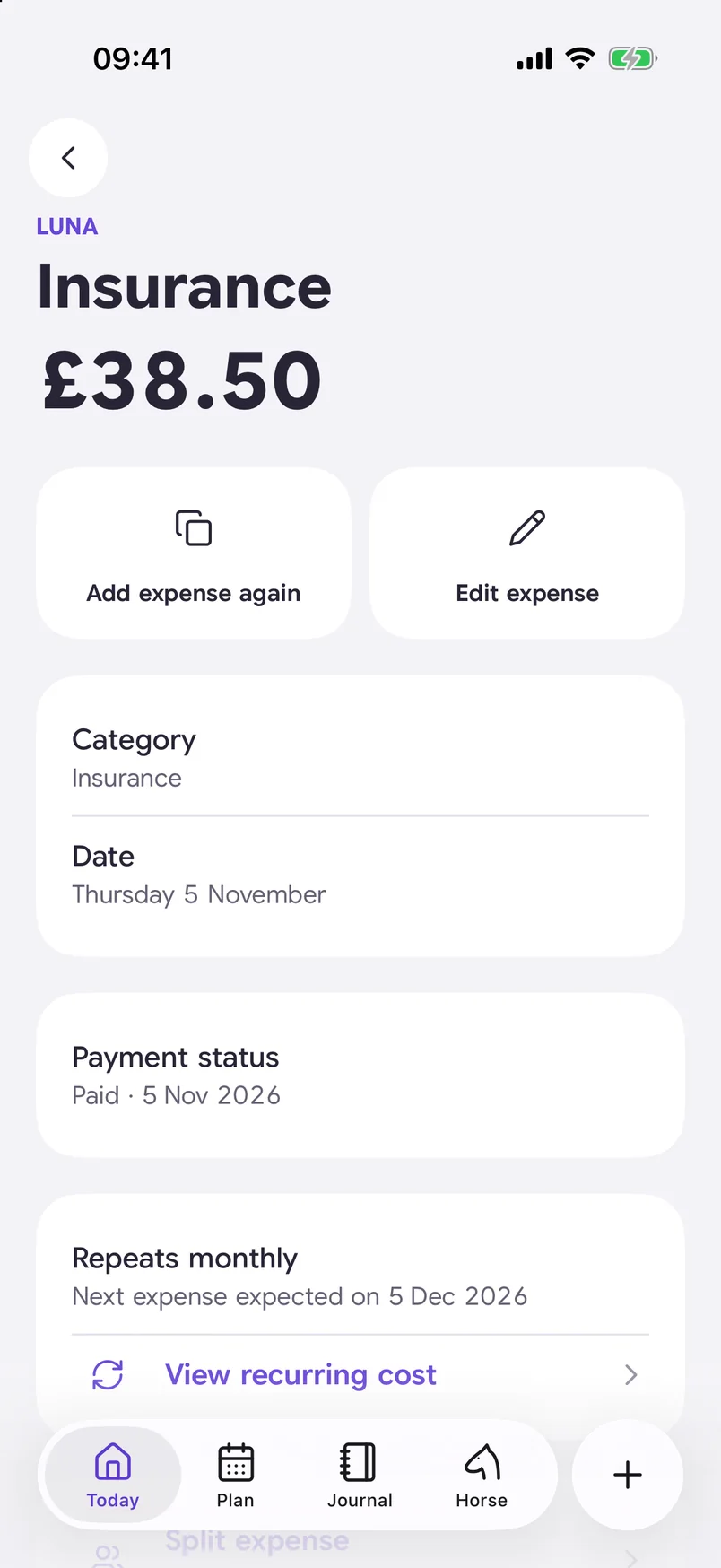
Start from what you actually paid: the University of Maryland Extension advises sorting receipts, card statements and vet records into categories per horse and marking each as a need or a want. Halster does the per-horse, per-category part as you go, keeping each cost with its receipt, category and visit.
How much does it cost to have a horse in different locations?
A lot more in some places than others. In August 2026, farmers in North Dakota got $89 a ton for hay and in New Mexico $275; board was, for example, about $396 a month per horse in Tennessee (2021 data, our division of TheHorse.com's yearly figure) and $1,600 for full board at one South Florida barn, and a lesson costs just under $50 in Tennessee against $100 or more in the mid-Atlantic (TheHorse.com).
How much is a 2 year old horse?
It depends on what it's bred for. At the 2025 Reno Snaffle Bit Futurity Sale, the four two-year-olds averaged $6,188, a small sample.
How much does a miniature horse cost, or a pony?
How much does a mini horse cost to buy? There's no reliable national price for a miniature horse or a pony, so this guide doesn't give one. A miniature horse can live 40 years or more, so its yearly bills run for a long time.