How Much Does a Farrier Cost? (2026 US Price Guide)
How much does a farrier cost? In American Farriers Journal's 2024 Farrier Business Practices Survey, full-time US farriers charged on average $60.42 to trim four feet and $178.76 to trim and set four steel keg shoes, and the Merck Veterinary Manual recommends that visit every 4 to 8 weeks. Over a year, owners in a 2023 Synchrony survey of 1,231 US horse owners spent on average $804, $1,196 or $1,710 on the farrier, depending on how they use their horse.
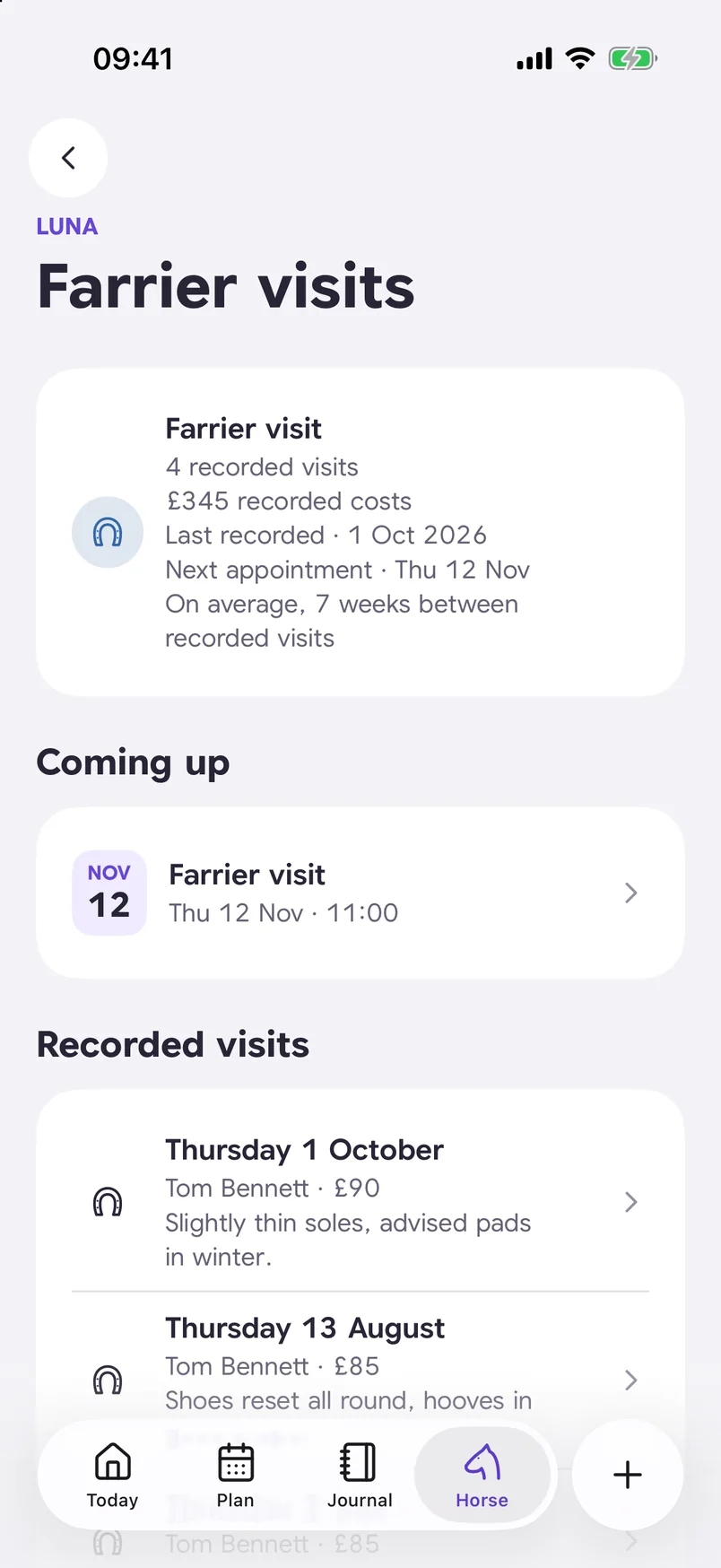
A farrier invoice tends to end up folded into a jacket pocket or pushed into a drawer in the tack room: a trim, two front shoes, and the next date scribbled at the bottom. By the time that date comes around, the paper has been through the wash, and you're standing in the barn aisle trying to work out whether the last visit was six weeks ago or nine, and whether the hind feet were done too. The price per visit is only half of the yearly bill; the other half is how often that date comes around, because the hooves keep growing whether the horse is ridden or not. Without the old invoices, nobody can say what the farrier has cost this year either.
US farrier prices at a glance
| Service type | Average cost | Frequency |
|---|---|---|
| Trim, four feet | $60.42 | Every 4 to 8 weeks |
| Trim, two front keg shoes | $126.55 | Every 6 to 8 weeks in summer |
| Trim, reset four keg shoes | $176.88 | Every 6 to 8 weeks in summer |
| Trim, four new keg shoes | $178.76 | Every 6 to 8 weeks in summer |
| Setting therapeutic or specialty steel shoes | $193.77 | Depends on the case |
| Trim, four glue-on shoes | $401.31 | Depends on the case |
| Barn call charge, if your farrier has one | $30.33 | Per visit |
Full-time farriers, US averages, American Farriers Journal survey published November 2024. Intervals from the Merck Veterinary Manual and the University of Kentucky.
On this page
Trims vs. shoeing: how much does a farrier cost per horse?
A farrier charges per horse and per visit, and in American Farriers Journal's 2024 survey a trim of four feet cost $60.42 on average while a trim with four new keg shoes cost $178.76, about $118 more. The survey is sent to farriers across the United States, so these are the prices farriers reported charging, not what owners said they paid. A farrier, in Merriam-Webster's words, is "a person who shoes horses", and the job also covers cleaning, trimming and shaping the hoof.
How much does a farrier cost for a trim?
A trim of all four hooves cost $60.42 on average with a full-time farrier and $54.47 with a part-time farrier in the 2024 survey. For a barefoot horse, that trim is usually the whole job. New Mexico State University puts it plainly: "Under most circumstances, trimming on a regular basis is sufficient", and horses should be shod when wear exceeds growth, to help performance, or as therapy. So the honest answer to how much does a farrier cost to trim hooves is about $60 a visit on the national average, with the farrier also checking the feet for signs of disease and lameness, as the National FFA Organization describes the work.
How much does it cost to shoe a horse?
Shoeing with a full-time farrier cost $126.55 for two front keg shoes and $178.76 for four in the 2024 survey, trim included, and steel keg shoes made up 74% of the shoes farriers used. Whether your farrier works hot or cold, the job is to remove the old shoes and fit new ones, as the FFA lists it. One owner's bill gives the other side: Bob Coleman of the University of Kentucky told TheHorse.com in 2026, "I have paid from $50 for a trim to $150 for front shoes, and for anything special the price goes up rather quickly." That is one specialist's own bills, not an average.
Experience shows in the price too. The University of Minnesota Extension says "a more experienced farrier can be expected to charge more", and in the 2024 survey full-time farriers charged on average $27.03 more per service than part-time farriers.
Regional breakdown: why location dictates your farrier bill
In American Farriers Journal's 2024 survey, a trim averaged $53.89 in the Central region and $68.69 in the Far West, and a trim with four keg shoes ranged from $150.00 in the West to $222.50 in the Northeast.
| Region | Trim four feet | Trim, four keg shoes |
|---|---|---|
| Northeast | $61.58 | $222.50 |
| Southeast | $56.08 | $182.33 |
| Central | $53.89 | $167.71 |
| Southwest | $60.22 | $164.00 |
| West | $66.54 | $150.00 |
| Far West | $68.69 | $182.41 |
| National | $60.42 | $178.76 |
Source: American Farriers Journal, November 2024, full-time farriers.
How much does a farrier cost in urban vs. rural areas?
The 2024 farrier survey splits prices by region, not by town and country, and the closest measure of distance is the trip charge. In 2015 Texas A&M's hospital farrier described how wide the gap can be: "What would be considered usury in rural Texas may well below average in New Jersey". For the going rate on your own road, the University of Minnesota suggests you ask other horse owners in your area or discipline what they pay for similar services.
The annual math: how much does a farrier cost per year?
In a 2023 US survey, owners spent on average $804 a year on the farrier for a backyard horse, $1,196 for a recreational horse and $1,710 for a competition horse, which is about $67 to $143 a month by our calculation. The Synchrony figures were reported by TheHorse.com. A 2023 Tennessee study, using 2021 figures, put farrier care at $404 a year in that state, and Coleman's own example comes to "$150 per visit with an average of seven visits per year (every six to eight weeks), that would be $1,050 per year."
The interval matters as much as the price. The Merck Veterinary Manual recommends trimming every 4 to 8 weeks, the University of Kentucky gives six to eight weeks in summer and six to twelve in winter, "but again, it depends on the horse," and the average hoof grows about 3/8 of an inch a month.
How much does a farrier visit cost over a year?
How much a farrier visit costs over a year is the price per visit times the visits: divide 52 by the weeks between visits. With the 2024 national averages for full-time farriers, our calculation gives:
| Visit every | Visits per year | Trim ($60.42) | Two front shoes ($126.55) | Four shoes ($178.76) |
|---|---|---|---|---|
| Every 6 weeks | 8.7 | $524 | $1,097 | $1,549 |
| Every 7 weeks | 7.4 | $449 | $940 | $1,328 |
| Every 8 weeks | 6.5 | $393 | $823 | $1,162 |
Trip charges, lost shoes and the vet come on top. With two or three horses on different cycles, few owners keep those dates and totals in their head.
The farrier is one line in the total budget; our guide to how much a horse costs adds up the rest.
How to keep your hoof care costs down
Keeping the farrier on schedule is the main way to hold hoof care costs down: the University of Kentucky warns that waiting too long lets hooves crack, which can lead to lameness.
A few habits make every visit go further. The University of Minnesota asks owners to have the horse caught, brushed and ready on a flat, clean and well-lit spot, to schedule and cancel appointments in advance, and to pay promptly. Keep stalls and paddocks from staying wet and dirty, since the University of Kentucky warns that wet, dirty conditions can cause thrush, which can lead to lameness; our guide to thrush in horses covers the rest. Work on ground manners between visits. And don't shop on price alone: the Minnesota farrier guide says, "Never choose a farrier based on cost alone."
Questions to ask your farrier
Before the first visit, the University of Minnesota advises that you understand your farrier's fee structure. Useful questions:
- What do you charge for a trim, a reset and new shoes?
- Do you add a mileage or barn call charge?
- How many weeks between visits suit my horse?
- How long have you been practicing, and which AFA certifications do you hold?
- Will you work with my vet if needed?
- How do I reach you in an emergency?
Write the answers down where you can find them again, because you may need them the morning a shoe is missing.
Conclusion: next steps for your farrier budget
On the 2024 US averages, a farrier costs about $60 for a trim and $179 for a trim with four keg shoes, and your yearly bill depends on the cycle, the shoes, your region and your horse's feet. As for how to find a farrier, the University of Minnesota says word of mouth is often the best route, through your vet and other owners. The American Farrier's Association's Find a Farrier search lets you find farriers in your area and review their AFA certifications. Look for one who works quietly around horses, turns up on time and calls when running late, then keep the schedule, the bills and the hoof history in one place.
More questions about farrier costs
Do farriers need a license?
No. The University of Minnesota Extension states that "no license or certificate is required" to trim and shoe horses in the US. The American Farrier's Association offers exams from Certified Farrier (CF) to Certified Journeyman Farrier (CJF), which Texas A&M describes as voluntary.
Should you tip your farrier?
We found no guideline on tipping from the AFA or a university. In a 2014 reader poll on TheHorse.com, which was not a representative survey, 71% of 1,727 owners said they don't tip their farrier, while others tip every visit or at the holidays.
Does shoeing hurt a horse?
Not when it is done well. The nails go through the outer hoof wall, which, as a 2001 TheHorse.com article on shoeing explained, contains no nerve endings. A misplaced nail that reaches sensitive tissue does hurt and can cause lameness.
How much does it cost to become a farrier?
It depends on the school. Cornell University's 16-week General Farrier Program lists a program fee of $8,500, although its sessions have been paused since the head farrier retired in 2025.